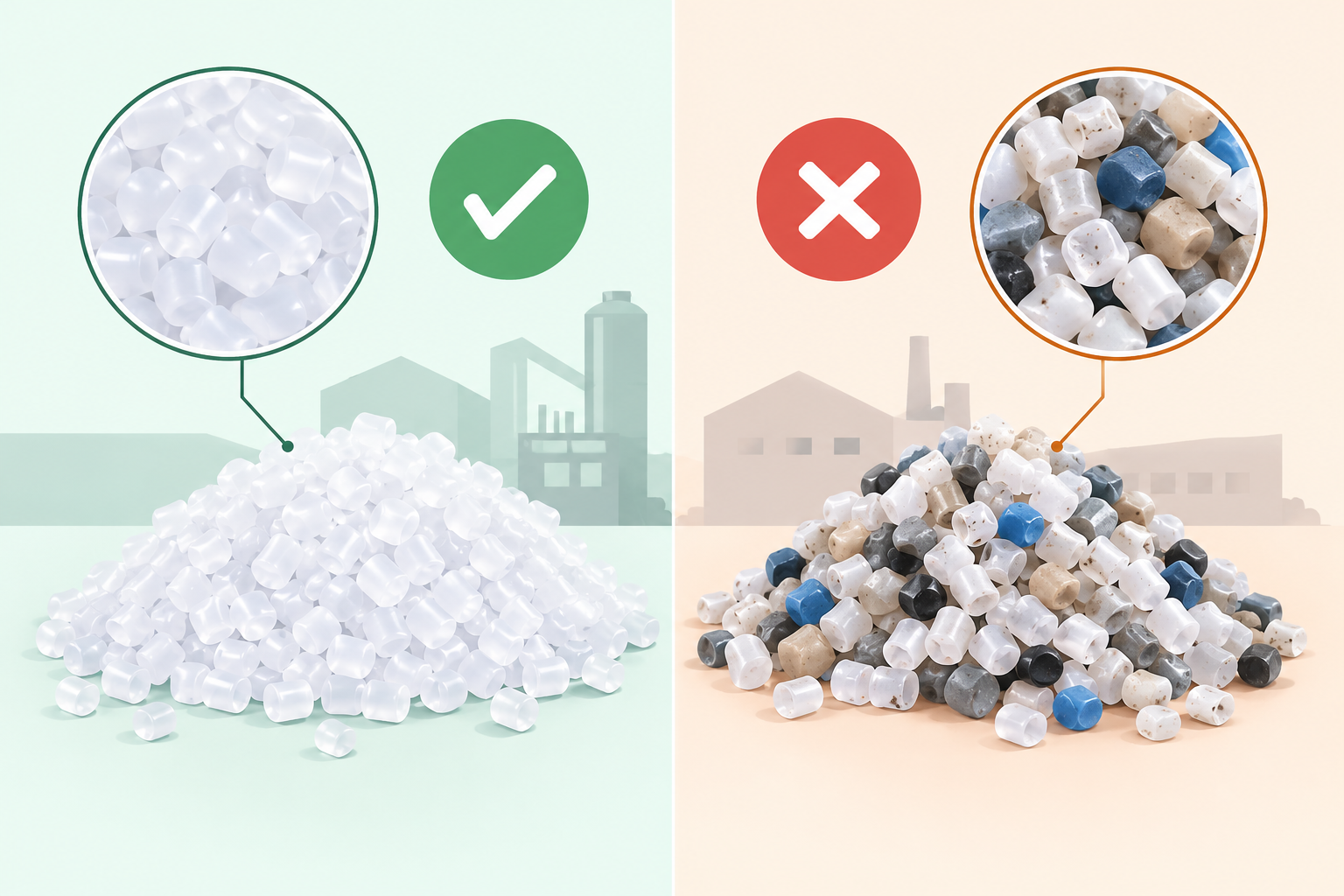
Polymer buyers often receive two quotes
for the same resin: one prime, and one marked off-grade at a few percent less.
The lower price is tempting, especially when margins are tight. Yet a cheaper
lot can become expensive if it runs badly on the production line.
This guide compares prime and off-grade
polymer resin on price, risk, and suitable applications, using producer price
list data. It helps buyers decide which grade fits a given job.
What Is Prime vs. Off-Grade Polymer Resin?
Prime resin is material that meets the
published specification for its grade. Off-grade resin is material that falls
outside that specification. Producers often make it when switching from one
grade to another, because a reactor can need to make up to three times its bed
weight in resin before properties settle.
Off-grade is not scrap. Off-spec material
often keeps many core properties of the standard grade, but its color,
strength, or flow can vary from lot to lot.
Key Differences Between Prime and Off-Grade Resin
|
Factor |
Prime |
Off-grade |
|
Specification |
Meets the grade spec |
Outside spec, to varying degrees |
|
Consistency |
Tightly controlled |
Varies by source and lot |
|
Price |
Higher |
Lower |
|
Best fit |
Critical or regulated uses |
Non-critical, cost-driven uses |
Producers list them under separate codes.
BCPL, for example, lists R38A040IA as prime and R38A040IOG as off-grade, with
the same melt flow target on the list.
Price Differences: How Much Does Off-Grade Really Save?
BCPL's Kolkata price lists show the gap
clearly (ex-works basic price, per MT):
●
PP Raffia, Feb 2026: prime ₹93,694 vs off-grade ₹89,694, a gap of ₹4,000 (about 4.3%).
●
PP Raffia, Jul 2026: prime ₹127,194 vs off-grade ₹123,194, the same ₹4,000 gap, now about
3.1%.
●
Roto grade, Feb 2026: prime ₹104,094 vs off-grade ₹95,594, a gap of ₹8,500 (about 8.2%).
One notable pattern is that the PP gap
stayed fixed in rupees while prices rose. As the market climbs, the percentage
saving shrinks. These figures come from one producer's list, so they work best
as a reference point and not a market rule.
Risks of Buying Off-Grade Resin
Variability is the defining trait of
off-spec material. Color, texture, or strength can differ from what is
expected, and a lot slightly off on melt flow can change how it runs on a
machine.
A grade name also proves nothing by
itself. Compounders say they sell a specification, not a grade, and buyers
benefit from thinking the same way. For food-contact or direct medical use,
grade datasheets note that special requirements apply, which a general
off-grade lot may not meet.
How to Evaluate an Off-Grade Lot Before Buying
Clear criteria protect buyers here. These
four checks help most:
1. Define the Minimum Specification
Write down the properties the product
needs, such as melt flow and strength, before looking at price.
2. Ask for Lot-Level Test Data
Where a spec needs a lot of testing,
reports should come with every shipment. Learning to understand polymer certificates of analysis
makes these reports far easier to read with confidence.
3. Inspect on Arrival
Datasheets remind processors to check
resin on arrival and to raise complaints promptly. A practical guide on how to check polymer quality before buying
covers the checks worth running.
4. Check Supplier Consistency
Suppliers with a record of consistent
off-spec material are worth keeping. It helps to compare
bulk polymer sourcing options and review supplier quotations side by
side before committing to a lot.
When to Buy Prime vs. When Off-Grade Makes Sense
Prime suits critical, regulated, or
tight-tolerance products, including food contact and medical use. Off-grade can
work for non-critical items where durability is adequate and cost matters more
than precision.
The real savings should also be weighed
against the risk. With a PP gap near 3% to 4%, off-grade deserves a second look
for anything where a failure is costly.
Practical Example (Illustrative)
Consider a buyer ordering 20 MT of PP
Raffia. At a ₹4,000/MT gap, off-grade saves ₹80,000 before GST and freight. If
one batch runs badly and needs rework or rejection, that saving can disappear
quickly. This is a hypothetical, built on the BCPL gap above.
Common Mistakes
●
Buying on price alone, with no
minimum spec.
●
Treating all off-grade as the same
quality.
●
Skipping lot test reports and
arrival checks.
●
Using general off-grade in
food-contact or medical products.
Key Takeaways
●
Off-grade is cheaper, but the PP
discount in these lists was small.
●
Variability is the main risk, so a
lot of data should be requested.
●
The grade should match how
tolerant the product is.
●
Every lot needs inspection, even
from trusted suppliers.
Conclusion
The right choice depends on what a
product can tolerate, not on the price gap alone. Defining the spec, asking for
test data, and comparing quotes side by side lead to better decisions. With
those steps in place, buyers can choose between prime and off-grade resin with
a clear view of what actually matters.
FAQs
What is off-grade polymer resin?
It is resin that falls outside the grade
specification, often made during grade transitions, and sold at a lower price.
How much cheaper is off-grade resin
than prime?
On BCPL's 2026 lists, the gap was about 3% to 8%
depending on the grade.
Is off-grade resin safe to use?
It can be fine for non-critical uses, but each lot
should be verified with test data.
Can off-grade resin be used for food
packaging?
Food contact carries special requirements, so
compliance should be confirmed with the supplier before using any off-grade
lot.
How do I check an off-grade lot before
buying?
Set a minimum spec, request lot-level test reports,
and inspect the material on arrival.