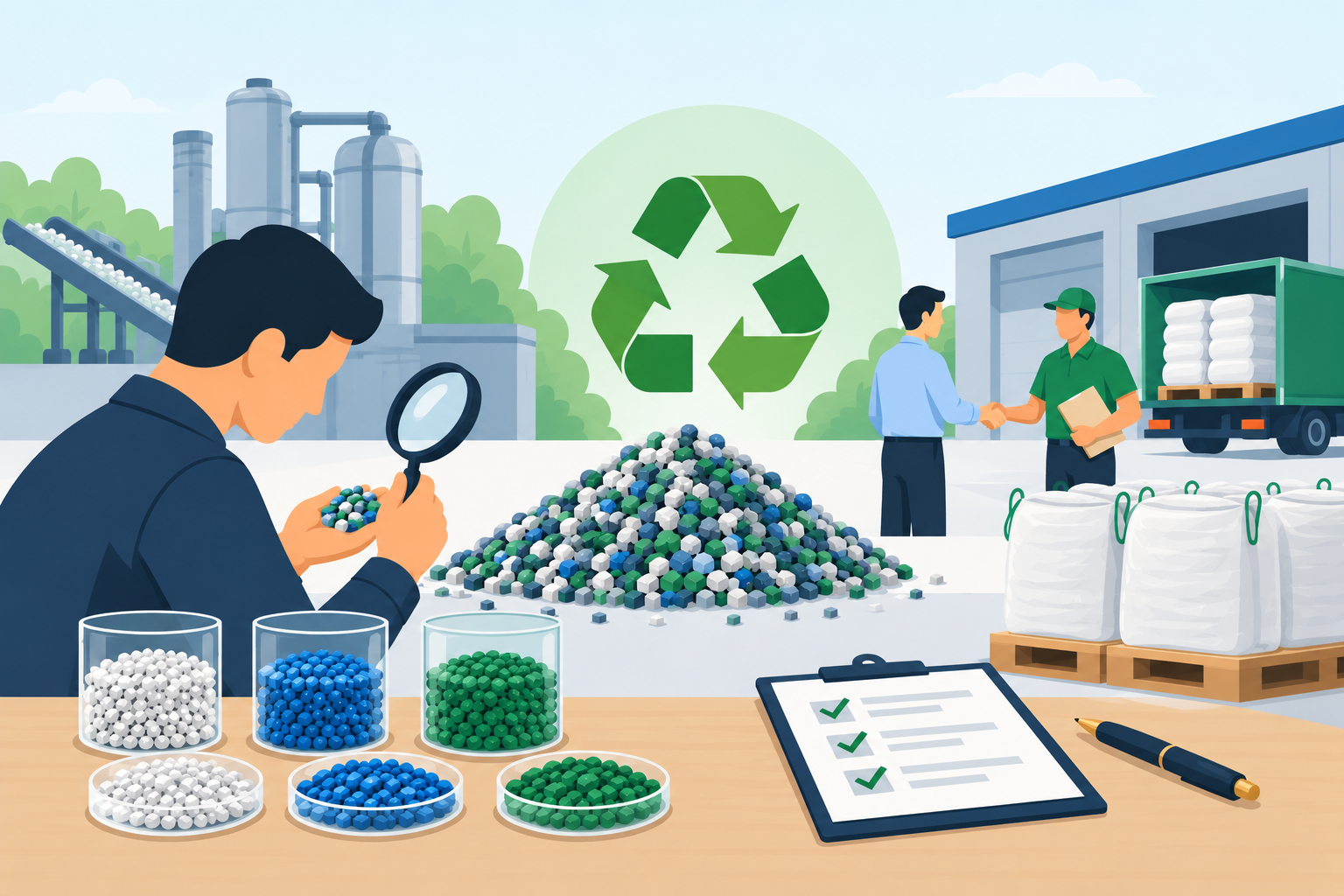
A supplier listing for recycled granules
usually shows a grade, a color and a price per kilogram. The harder questions
come after the order: whether the lot will run on the existing machine, whether
the paperwork will hold up in an audit, and whether the next batch will match
the first.
Buyers searching for recycled polymer
granules in India are often manufacturers facing new recycled content targets
or processors trying to lower raw material costs. This guide covers what to
check, in what order, and which mistakes cost the most.
What Are Recycled Polymer Granules?
Recycled polymer granules are plastic
pellets made by cleaning, melting and re-pelletizing used plastic. The source
is either post-industrial waste, such as clean factory scrap, or post-consumer
waste collected from mixed streams. Common types include rPP, rHDPE, rLDPE,
rABS and rPET. Recycler Gravita notes that post-industrial material is
generally more consistent.
Why Demand for Recycled Granules Is Rising in India
The Plastic Waste Management (Amendment)
Rules, 2026 were notified on 31 March 2026 and set minimum recycled content for
packaging. For FY2025-26, rigid packaging (Category I) needs 30%, flexible
packaging (Category II) 10% and multi-layered packaging (Category III) 5%. By
FY2028-29, these rise to 60%, 20% and 10%.
Recycled content in imported packaging
does not count, and recycled plastic must conform to IS 14534:2023 and carry
labelling. Food and pharma packaging is exempt where other regulations restrict
recycled material. For buyers, documentation now matters as much as price.
Key Factors to Consider Before Buying
Recycled granules vary far more than
virgin resin, so the right criteria matter. The five factors below move from
low-cost paperwork checks to hands-on testing, which lets a buyer drop a weak
supplier early.
1. Match the
Polymer and Grade
Start with the application. Gravita notes
that recycled PP performs close to virgin in crates, buckets, non-visible
automotive parts and non-food woven sacks. Food contact, medical packaging and
color-critical parts usually need virgin or specially certified material.
Then compare polymer grades using technical data sheets,
checking that test methods and conditions match. PP melt flow index (MFI) is
commonly tested at 230°C and 2.16 kg, and values only compare under the same
conditions.
2. Check the
Source and Batch Consistency
A single good sample proves little. In a
2025 Polymer Char case study, three well-blended batches of post-consumer rPP
from the same source differed in MFI by up to 45%, which caused incomplete
filling of large parts. Ask for MFI data across several recent batches and
confirm whether the material is post-industrial or post-consumer.
3. Verify
Documentation and Compliance
Request the supplier’s registrations and
authorisations, recycled content records and a certificate of analysis (COA)
for each lot. Corpseed’s audit guide lists CPCB and SPCB authorisations, EPR
compliance and raw material traceability among the items to review. Buyers who
need the material to count toward EPR targets should confirm in advance that
the supplier can supply the records.
4. Test Before
Committing
Polymer quality inspection before buying does
not need a full laboratory. Match the COA lot number to the bags, inspect
pellets for contamination, moisture and color variation, and test MFI. FTIR,
DSC and TGA add certainty on larger orders. Then run a trial batch on the
buyer’s own machine before ordering volume.
5. Compare Price,
MOQ and Supplier Terms
Recycled granules are usually cheaper,
but not by a fixed margin. Gravita puts the average discount at 20% to 30%
against virgin, though that is a supplier figure. Trade India listings show
wide gaps in price and minimum order quantity, from 1 kg to 600 kg for PP
granules, so quotes need like-for-like comparison.
Buyers can source
bulk polymer raw materials online through Polymers Bazaar, where one
RFQ reaches multiple verified sellers for side-by-side quotations. The platform
states that product quality remains the seller’s responsibility, so the testing
steps above still apply.
Practical Example
This scenario is illustrative, not a real
case. A manufacturer of non-food storage crates wants to replace part of its
virgin PP with rPP. It compares the data sheet MFI with its molding process,
requests MFI results from the supplier’s last several batches and confirms the
material is post-industrial. On arrival, the COA lot number is matched to the
bags and a trial batch runs on existing tooling. Only after it molds cleanly
does the manufacturer raise the order, starting with a blend rather than 100%
recycled material.
Common Mistakes
●
Buying on price and color alone,
with no data sheet or COA review.
●
Treating one sample as proof of
consistent supply.
●
Not knowing whether the material
is post-industrial or post-consumer.
●
Using recycled material in
food-contact or color-critical parts without proper certification.
●
Skipping documents the buyer’s own
compliance filing may need.
Key Takeaways
●
Fit the grade to the application
first.
●
Judge suppliers on multi-batch
data, not one sample.
●
Collect documents before the first
order.
●
Test and trial before scaling up.
●
Compare quotes on equal terms.
Conclusion
Buying recycled granules well means
treating them as a controlled input, not a commodity. When the grade fits the
application, batches are consistent and the paperwork is in order, recycled
material can cut costs and support recycled content targets without disrupting
production. A short, repeatable checklist is usually enough to get there.
FAQs
Is recycled content mandatory in
India?
Yes, for packaging producers, importers and brand
owners, starting at 30% for rigid packaging in FY2025-26 and rising to 60% by
FY2028-29.
Can recycled PP be used for food
packaging?
Generally no, unless it carries specific food-grade
certification under FSSAI rules.
How much cheaper is recycled PP than
virgin PP?
Gravita cites an average discount of 20% to 30%,
though actual prices vary by grade, color and quality.
Which tests matter most before buying?
MFI and density suit routine checks, while FTIR, DSC
and TGA add certainty on larger orders.
Should the first order be 100%
recycled material?
Many manufacturers start with a blend, and Gravita
notes that 20% to 30% recycled content mixed with virgin is common for
borderline applications.